
100-Amp Panel and an EV Charger in Georgia: Upgrade, Load Management, or Neither?
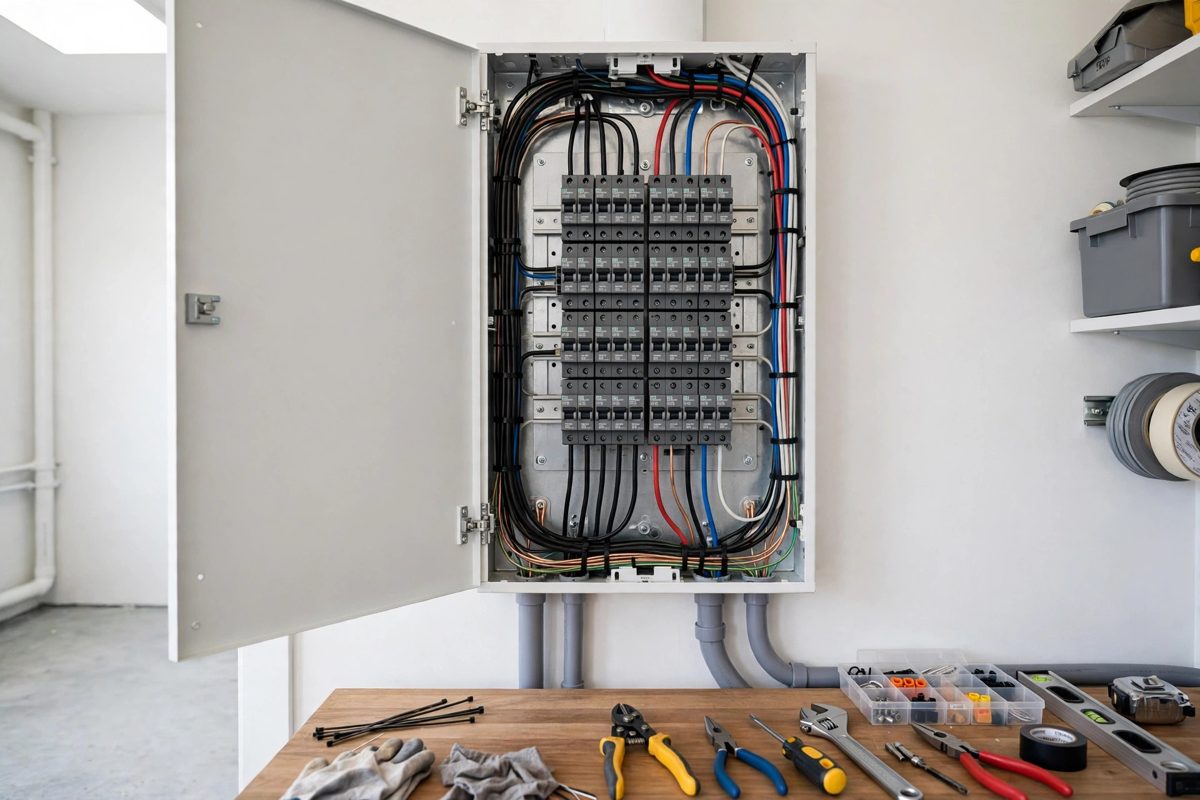
Georgia Home Charger is a statewide referral service. We connect you with licensed, insured independent electricians in Georgia. We do not perform installations ourselves - the independent local electrician who visits your home performs the work.
If your Georgia home has a 100-amp panel and you want a Level 2 EV charger, you have probably heard two opposite claims: "100 amps is fine, just install it" and "100 amps means you must upgrade to 200 amps first." Both can be wrong. The truth is in the middle, and it depends on a calculation, not a slogan.
This guide explains that calculation in plain language, so you can tell whether you need an upgrade, whether load management will do, or whether neither is needed - before you pay for work you do not need, or skip work you do need.
What 100 amps actually means
Your panel size is a budget, not a speed limit for one appliance. A 100-amp service can deliver up to 100 amps in total at a given moment. Everything in the house draws from that budget at the same time: air conditioning, electric range or oven, dryer, water heater, and now a Level 2 charger, which by itself can draw 32, 40, or 48 amps depending on the circuit.
That is why "my neighbour has 100 amps and a charger, so I can too" is not proof. Your neighbour's house may have gas cooking and gas water heating, a smaller air conditioner, and a driver who charges only overnight. Your house may be all-electric, with a larger air conditioner and a dryer that runs in the evening. Same panel label, very different budget.
The load calculation is the decision, not an extra
A licensed electrician should do a load calculation before recommending a charger size or an upgrade. In simple terms, the calculation adds up the house's major loads at their expected peak, applies the rules in the electrical code for diversity (not everything runs at full power at the same instant), and checks what headroom is left for a continuous EV load.
There are only three honest results:
- Room as-is. The calculation shows comfortable headroom for the charger you want, on a dedicated circuit, without changing anything else. This is common in homes with gas appliances, a modest air conditioner, or a driver who charges at a moderate amperage.
- Room with load management. The calculation shows the house is tight at peak, but safe if charging is managed. A load-management device or a smart charger with load sharing monitors total house load and pauses or reduces EV charging when the house approaches its limit, then resumes when load drops. For many Georgia drivers, this is the sweet spot: overnight charging, when the dryer and oven are off and the air conditioner cycles down, rarely needs full power at the same moment as everything else. Load management is not a workaround to hide an unsafe install. Done properly, with a listed device and a correct calculation, it is a code-recognised way to stay within the service capacity.
- Upgrade needed. The calculation shows the house is genuinely at or over capacity even with management, or the panel itself is old, damaged, has no spare space, or cannot safely accept the new circuit. Then a panel upgrade (often 100 amps to 200 amps), a subpanel, or a service upgrade is the right call. It is the most expensive outcome, and it is also the outcome that makes the house safer and more future-proof for a second EV, a heat pump, or an induction range later.
An installer who skips the calculation and jumps straight to "you need 200 amps" may be selling work you do not need. An installer who skips the calculation and jumps straight to "just put in a 48-amp charger" may be creating a tripping - or unsafe - problem. Ask to see the calculation, in plain numbers, before you agree to either.
Older Georgia homes: what else to check
In older Atlanta, Savannah, and Athens homes, the panel label is not the whole story. Check: Is the panel itself in good condition, or is it a brand or type known for problems? Is there physical space for a new two-pole breaker, or is the panel already full? Is the wiring to the garage in good condition, or will a long run through an attic, crawlspace, or outside wall need upgrading anyway? Is the service entrance - the wires and meter feeding the house - sized for an upgrade if one is needed, or would an upgrade also mean utility work?
Those questions explain why two 100-amp homes can get very different quotes. One needs only a circuit. The other needs a panel, and possibly utility coordination, and the quote should say which one you are.
What size charger should a 100-amp home actually use?
There is no single answer, but there is a sensible order: (1) work out your daily driving and overnight window; (2) work out what circuit size restores that driving overnight; (3) check that size against the load calculation; (4) if it does not fit, either lower the charging amperage, add load management, or upgrade - in that order of cost.
The recommended charging output depends on daily driving, the vehicle and the electrical assessment. For example, Tesla lists 32A output on a 40A breaker and 48A output on a 60A breaker. Select a lower output or approved load management when appropriate; do not infer capacity from the service label alone.
Two-EV households need the same logic, twice. Power sharing between two chargers - where the total is capped and shared - often lets a 100-amp home serve two cars overnight without a full upgrade, provided the calculation and the sharing device are set up correctly.
Cost: what moves the price, without inventing a quote
A panel upgrade is usually the largest single cost driver in an EV install, and it is also the most variable: panel condition, service size, utility work, and the distance to the garage all move it. Load management is usually far less expensive than a full upgrade, and a straightforward dedicated circuit with no panel work is less expensive again. That ordering - circuit first, load management second, upgrade third - is why the calculation matters so much. Paying for an upgrade you do not need wastes the most money. Skipping an upgrade you do need wastes safety.
Installation cost depends on the equipment, electrical capacity, cable route, panel work and local permit requirements. Request a written, itemized quote that separates equipment, labor, permits, inspection and exclusions. No fixed installation price is offered on this page.
Questions to ask before you agree
Ask: Can I see the load calculation? What charging amperage are you recommending, and what daily range does that restore overnight for my car? If I choose load management instead of an upgrade, what device are you using, and what happens if the house peaks? If I do need an upgrade, is it panel-only, or does the service entrance or utility need work too? What is included - circuit, charger, permit, inspection, testing - and what would change the price?
If those answers are clear, you have a plan you can trust, whether it ends in a circuit, a load-management device, or a full upgrade.
Georgia Home Charger connects Georgia homeowners with licensed, insured independent electricians for panel checks, load management, and panel upgrades for EV charging. (470) 290-6391. See also: Electrical Panel Upgrade for EV Charger and Level 2 EV Charger Installation.
Back to the Georgia Home Charger blog · EV charger installation in Georgia
Georgia Home Charger guide for homeowners. Confirm electrical requirements with a qualified electrician and current program rules with the program operator.
Call Georgia Home Charger Now: (470) 290-6391
Electrical sizing: charger output is not the breaker rating. For example, Tesla lists 32A output on a 40A breaker, 40A on 50A, and 48A on 60A. A qualified electrician must confirm the equipment, load calculation and applicable requirements. Overnight timers alone do not replace approved capacity-control equipment. Manufacturer sizing reference