
Home EV Charger Installation in Georgia
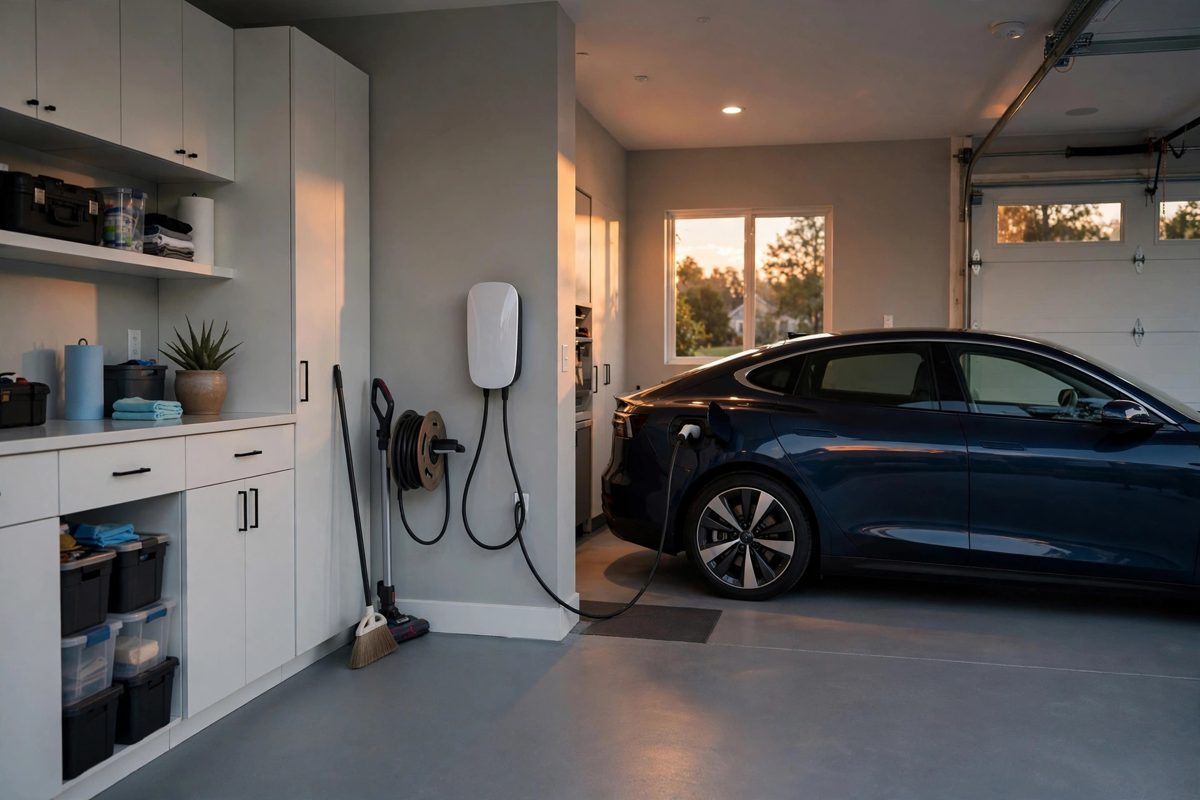
A home EV charger is not just a box on the wall. It is a dedicated circuit, a panel check, a parking setup, and a charger matched to your car — installed by a licensed, insured independent electrician in Georgia, connected through Georgia Home Charger.
What home EV charger installation involves
A home install starts with a load calculation and a parking walk: where the panel is, how far the cable must run, whether the charger will be indoors or outdoors, and whether the car parks in a garage, carport, or driveway. The electrician then installs a dedicated circuit, mounts the charger, and tests it. Georgia-wide dispatch through our statewide network follows that same sequence in every county, because skipping the panel check is how good installs go wrong.
Garage installs are usually simplest, because the panel and the car are close and the charger is protected. Outdoor and driveway installs need an outdoor-rated charger, correct mounting height, and weatherproofing — especially in humid coastal areas such as Savannah. Detached garages add cable length and sometimes trenching or conduit, which is why distance, not just charger price, moves the quote.
One EV, two EVs, and dual-charger setups
For two EVs, power sharing is often the smartest route: two chargers share a capped total, so the house never exceeds its safe capacity, and both cars still charge overnight. This can avoid a full panel upgrade in homes that are tight at peak. Tell the dispatcher about both cars, their daily mileage, and whether they charge at the same time — that determines whether sharing works or whether a larger circuit is genuinely needed.
When to call a professional immediately
Call before you buy a charger if your panel is already full, if breakers trip regularly, if the panel is damaged or very old, or if the cable route crosses a driveway, a detached garage, or standing water. Do not run a Level 2 charger on a shared household circuit or an extension lead. A dedicated circuit, installed and inspected, is the safe baseline.
Related Georgia pages: EV charger installation in Atlanta EV charger installation in Savannah EV charger installation in Athens — and back to the statewide hub, EV charger installation in Georgia.
Georgia Home Charger is a statewide referral service. We connect you with licensed, insured independent electricians in Georgia. We do not perform installations ourselves — the independent local electrician who visits your home performs the work.
Planning a home charger setup that still works in five years
A home charger is not a single purchase, it is a setup that has to live with your household for years. The charger itself is the visible part, but the circuit, the mounting location, and the panel capacity are the parts that decide whether the setup still works when you change cars, add a second car, or move the parking spot. Planning those three things at the start costs little and avoids the most common regret: a charger installed for one car, in one spot, on a circuit that cannot grow.
Start with the parking spot as it will be in daily use, not as it looks on install day. Where does the car actually sleep, how does the cable reach it without crossing a walkway, and is there room to open the charge port without moving another car? Then look at the panel: is there room for a dedicated circuit, does the load calculation support the charger size you want, and would load management let you charge overnight without a panel change? A good electrician answers those questions in that order. A charger-first conversation that never asks about the panel is a conversation to walk away from.
Garage, outdoor and two-EV setups
Garage installs are the simplest case: short cable runs, weather protection, and a wall that belongs to you. Outdoor installs need a different checklist — enclosure rating, mounting height, cable storage, and protection from standing water — and they should be quoted as outdoor installs, not as garage installs with the charger moved outside. Two-EV setups need a third checklist: load management, power sharing, or a second circuit, decided before the first charger goes in. If a second EV is likely, say so, because retrofitting power sharing after a single-charger install is more expensive than planning for it.
For most Georgia households, the practical home setup is a mid-size Level 2 circuit, a charger that works with more than one car brand, and a mounting location that keeps the cable short and safe. That setup charges overnight, survives a car change, and can grow to a second car with load management. It is not the most expensive setup, and it is not the fastest on paper. It is the setup that still makes sense in five years, which is the only timeframe that matters for work wired into your home.
Permits, inspection, and rebates apply to a home install just as they do to any other charger job. A licensed electrician should handle permits and inspection where required for a new circuit or hardwired install, and Georgia Power's residential rebate — up to $150 on its official page in October 2026, while funds last — is worth checking before you budget, whether you choose a hardwired charger or a plug-in charger on a NEMA 14-50 outlet.
If a rebate affects your budget, read our Georgia Power EV rebate guide and check the current official rebate page before you rely on any figure.
If the charger itself has failed rather than the install, see EV charger replacement in Georgia before ordering a new install.
Frequently asked questions
How long does a home EV charger install take?
Most standard installs are completed in a few hours once the electrician is on site, with reported ranges of 1 to 4 hours for standard residential installs in Georgia checks. Panel work, long cable runs, or trenching take longer and should be quoted separately.
Should I buy the charger before I call?
You can, but it is often better to call first. The electrician can confirm the circuit size and charger fit for your panel and car, so you do not buy a charger your house cannot support at full power.
Is it better to install an EV charger inside or outside my garage?
Inside is usually better where it is possible, because the charger and cable stay out of rain and heat. If the car parks outside, on a driveway, or in a detached garage, use an outdoor-rated charger and mounting that can handle Georgia rain and humidity year after year, and plan the conduit route before you choose the charger location.