
Level 2 EV Charger Installation in Georgia
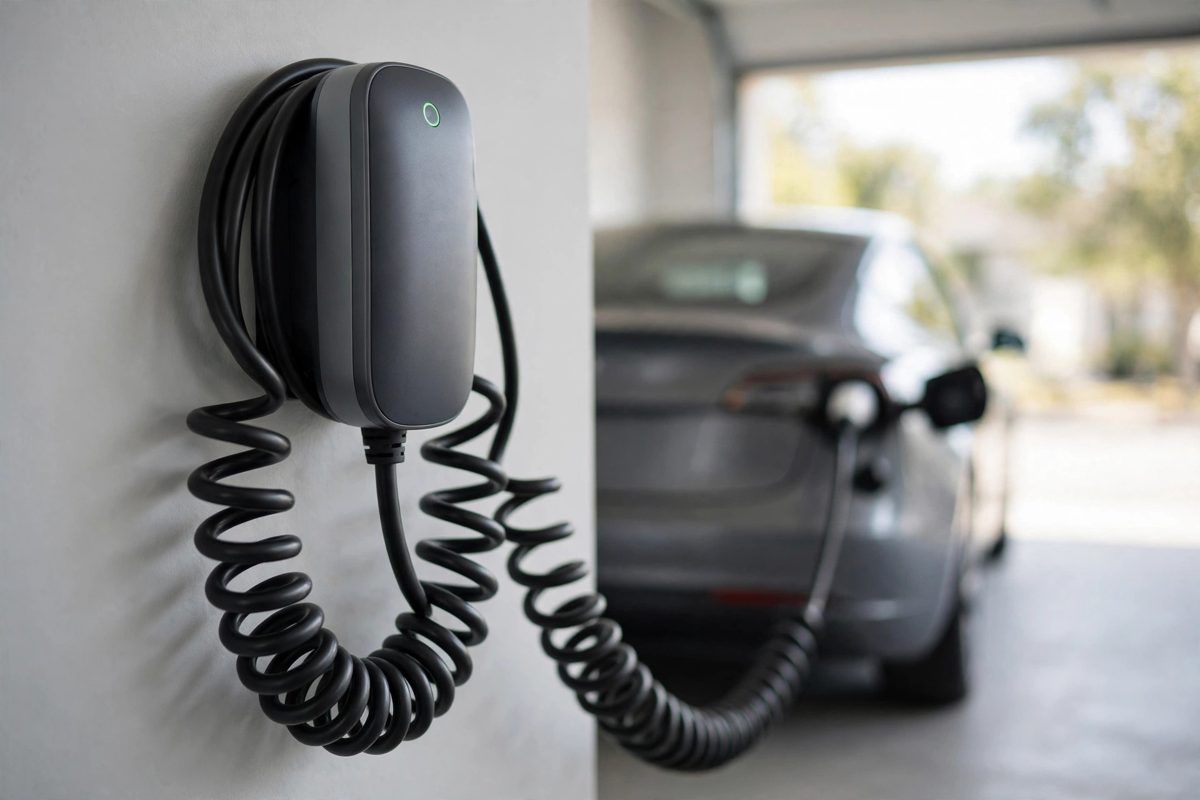
Level 2 is the standard home charging choice in Georgia: a dedicated 240-volt circuit that restores daily driving overnight, several times faster than a standard wall outlet. This page explains sizes, hardwired versus plug-in, and what your panel must support.
What Level 2 charging means
Level 2 uses a dedicated 240-volt circuit, the same voltage class as a dryer or oven, on its own breaker. It is not a faster plug in a normal socket. The circuit, the charger, and the car together set the speed: a 40-amp, 48-amp, or 60-amp circuit only helps if the car can use that power and the panel can supply it safely. The statewide EV charger installation network in Georgia matches circuit size to car and panel, not to the largest number on a box.
Hardwired or plug-in?
A hardwired charger is fixed to the wall with no plug to loosen, and is often cleaner for outdoor or detached-garage installs. A plug-in charger on a NEMA 14-50 outlet lets you take the charger with you, swap it later, or leave a useful outlet for the next owner — a real advantage for renters and frequent movers. Both need the same dedicated circuit and inspection; the choice is about flexibility, not safety shortcuts.
40A, 48A, and 60A: how to choose
Start from daily driving and overnight window, not from maximum amperage. Many drivers restore a full day on a 32-amp or 40-amp circuit. A 48-amp circuit helps drivers with longer commutes or cars that can use it. A 60-amp circuit helps only a smaller group, and only if the panel supports it. A load calculation, not a sales pitch, should set the number.
Cost factors in Georgia
Reported Georgia ranges from October 2026 checks include Atlanta installs around $899 low, about $1,600 average, and $3,700 high, and a Georgia Level 2 range of $300 to $1,200 in AI-overview summaries. Those are reported ranges, not Georgia Home Charger prices. Your quote depends on panel work, cable distance, charger choice, and permit and inspection. Get it itemised in writing.
Related Georgia pages: EV charger installation in Smyrna EV charger installation in Kennesaw EV charger installation in Duluth — and back to the statewide hub, our statewide referral service in Georgia.
Georgia Home Charger is a statewide referral service. We connect you with licensed, insured independent electricians in Georgia. We do not perform installations ourselves — the independent local electrician who visits your home performs the work.
Choosing a Level 2 circuit size: 40, 48 or 60 amps
Level 2 charging is not one speed. The circuit size decides how much power the charger can deliver, and the right size depends on your car, your panel, and your daily distance — in that order. A smaller circuit is enough for a short commute charged overnight. A larger circuit matters for a longer commute, a larger battery, or a household that needs a meaningful charge in a few hours rather than overnight. The mistake is to buy the largest charger first and ask about the panel second. The panel and the load calculation decide what is safe, and the car and the commute decide what is useful within that safe range.
Hardwired versus plug-in is the second Level 2 decision, and it is not just about convenience. A hardwired charger is a permanent fixture, usually able to use the full circuit, and the cleaner choice for a long-term home. A plug-in charger on a NEMA 14-50 outlet is more flexible: the charger can move, the outlet stays, and a renter or a future mover keeps their options open. The trade-off is that a plug-in setup has its own code and safety requirements, including the outlet type and protection, which the electrician should explain rather than assume. Neither choice is universally better. The right one follows from how long you will live in the home and whether the charger needs to travel.
Load management and overnight charging
Load management is the option most households never hear about until it is too late. If your panel cannot support a large charger on its own, load management lets the charger use spare capacity and pause or reduce power when the house needs it — for example, when the air conditioning or dryer is running — and resume overnight when demand falls. For many homes, that avoids a panel upgrade entirely. For others, it is a bridge: charge overnight now, upgrade the panel later when other electrical work is planned anyway.
Overnight scheduling is the other half of the same idea. Most Georgia households charge at night, when the car is parked for hours and the house is quiet. A charger that can schedule charging for overnight hours, and a circuit that is sized for that overnight window rather than for a midday fast charge, is usually the cheapest setup that still wakes up to a full battery. Tell the electrician your daily distance and your parking hours, because those two numbers, not the charger's headline speed, are what size the circuit correctly.
Level 2 circuit sizes at a glance
| Circuit size | Best for | Panel note |
|---|---|---|
| 40-amp circuit | Shorter daily commutes charged overnight | Most likely to fit without panel work, subject to a load calculation |
| 48-amp circuit | Longer commutes and larger batteries | Needs a load calculation; hardwired in most cases |
| 60-amp circuit | Fastest home charging and future-proofing | Panel check is essential; a panel change or load management may be needed first |
These are general guidance ranges, not guarantees for your home. Your car, your panel, and your daily distance decide the right size, and the final quote depends on that check.
If your existing charger has failed or no longer suits your car, see EV charger replacement in Georgia. And if a rebate affects your budget, read our Georgia Power EV rebate guide and check the current official rebate page before you rely on any figure.
Frequently asked questions
Is Level 2 worth it if I drive very little?
If you drive under about 20 miles most days, Level 1 may cope, but Level 2 still gives you a full overnight charge, a dedicated safe circuit, and a home setup that works if your driving increases. For most Georgia commuters, Level 2 is the practical choice.
Does Level 2 need a permit?
For a new circuit or hardwired install, a licensed electrician should handle permits and inspection where the local authority requires them. Requirements vary by county and city, so confirm with your matched electrician, not with a guide from another state.
How much does a Level 2 charger cost?
Keep the charger unit and the installation apart. Reported market ranges from October 2026 Georgia checks put a Level 2 charger unit roughly in the $350 to $900 range, while the total install, including labour, wiring, and any panel work, is a separate figure. Your final quote depends on the charger you choose, your panel, and the cable distance.
Can I install a level 3 charger at my house?
No, not practically. Level 3 is DC fast charging, built for commercial sites with high-power electrical service and expensive equipment. It is not a home product. Level 2 on a dedicated 240-volt circuit is the home standard, and for most drivers it restores a full overnight charge.