
Electrical Panel Upgrade for EV Charger in Georgia
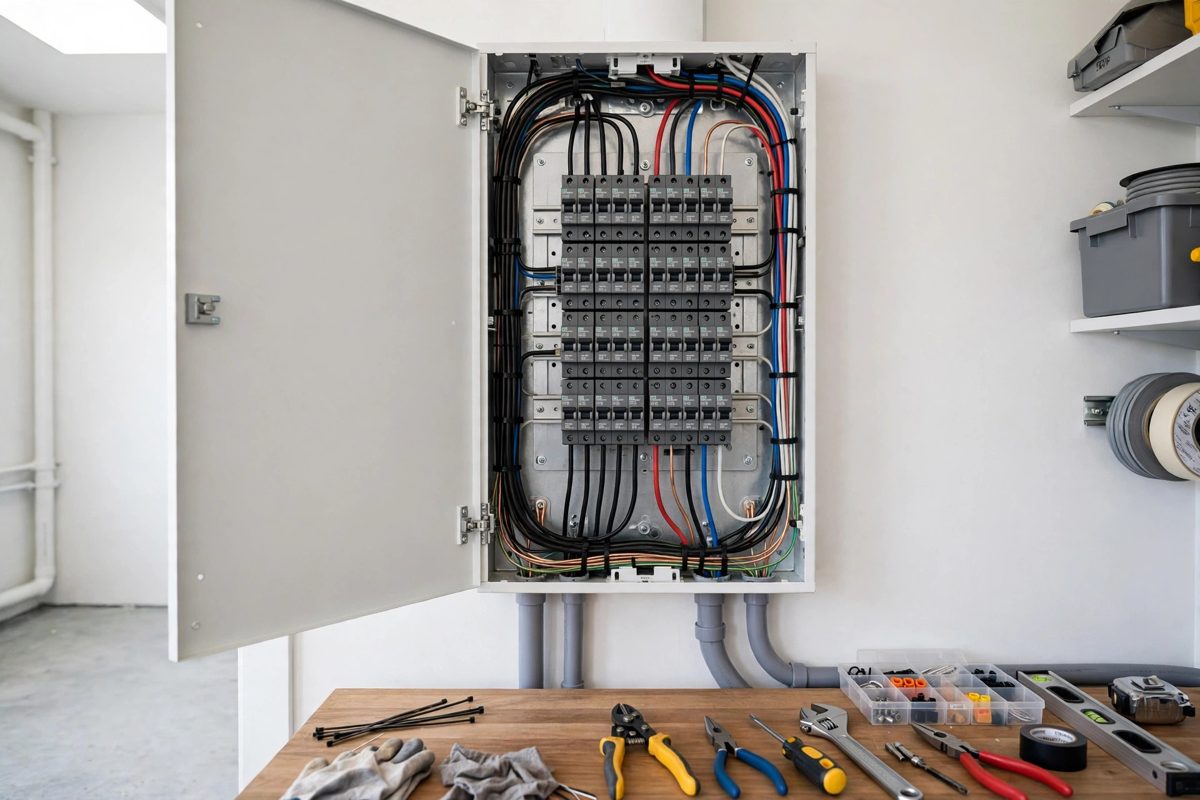
Sometimes a home charger needs a bigger panel first. Sometimes it needs load management instead. Sometimes it needs neither. This page explains how a licensed electrician decides — with a load calculation, not a guess — for Georgia homes from Atlanta suburbs to older Savannah and Athens houses.
100 amps to 200 amps: when it is real
A 100-amp panel is a budget. Air conditioning, dryer, oven, and water heating already spend most of it at peak. Adding a 40-amp or 48-amp charger on top can exceed that budget. A load calculation adds up peak loads under code rules and checks headroom. If the house is genuinely over capacity, a 100-amp to 200-amp upgrade, or a subpanel for the charger, is the right call. It also future-proofs the house for a second EV or a heat pump. See our original guide, 100-amp panel and an EV charger in Georgia, for the full decision walk-through.
Load management as an alternative
Load management monitors total house load and pauses or reduces EV charging when the house approaches its limit, then resumes overnight when other loads drop. For many drivers, this avoids a full upgrade entirely, because overnight charging rarely coincides with peak cooking and laundry. A listed load-management device, set from the calculation, is a recognised solution — not a way to hide an unsafe install.
Subpanels, breaker space, and service entrances
A subpanel can give a charger its own space without replacing the main panel, if the service can support it. No spare breaker space, a damaged or obsolete panel, or a service entrance too small for an upgrade can each change the job. Your electrician should explain which one applies to your house, and whether utility work is needed, before quoting a panel price.
Cost drivers, without a fixed quote
Panel upgrades were reported in Metro Atlanta checks from around $1,595 to $3,000 or more. That is a reported range, not a Georgia Home Charger price. Panel condition, service size, utility coordination, and distance to the garage move the price more than the panel label alone. Get an itemised quote with the load calculation attached.
Related Georgia pages: EV charger installation in Savannah EV charger installation in Athens EV charger installation in Atlanta — and back to the statewide hub, EV charger installation in Georgia.
Georgia Home Charger is a statewide referral service. We connect you with licensed, insured independent electricians in Georgia. We do not perform installations ourselves — the independent local electrician who visits your home performs the work.
How a load calculation actually decides the answer
A load calculation is not a guess and it is not a sales tool. It is a methodical accounting of what your home's electrical service already supplies — heating, cooling, cooking, water heating, laundry, and everything else on the panel — against what it can safely supply in total. The result decides, in order, whether a charger fits as-is, whether it fits with load management or overnight scheduling, or whether the panel or service genuinely needs to change first. Any electrician who recommends a panel upgrade without showing you that calculation, or who promises a large charger without asking about the panel at all, is skipping the step that makes the recommendation trustworthy.
The calculation also explains why two similar-looking homes get different answers. A home with gas heating and cooking has more electrical headroom than a home where everything is electric, even if the panels look identical. A home with a newer, larger service has more room than a home on an older, smaller service. That is why a photograph of the panel label, a list of the major electric appliances, and the service size are the three pieces of information that matter most before a quote, and why a quote given without them should be treated as a range, not a promise.
Subpanels, service upgrades and timing the work
Not every panel problem needs a full service upgrade. A subpanel can add circuit space where the main panel is full but the service itself has capacity. A load management device can let a charger use spare capacity without new service at all. A full upgrade from a smaller service to a larger one — commonly from 100 amps to 200 amps in Georgia homes — is the right answer when the service itself is the limit, not just the panel space, and it is also the most disruptive and expensive option, so it should be the last resort, not the first suggestion.
Timing matters too. If other electrical work is already planned — a renovation, a new air conditioning system, or a panel replacement for age — combining the charger work with that work can avoid paying twice for the same disruption. If no other work is planned, load management or a subpanel may be the smarter bridge. Tell the electrician about any planned work, because it changes the recommendation, and ask for the options in order: as-is, load management, subpanel, full upgrade, with what each one costs and what each one enables. That ordered list is the sign of an honest panel conversation.
Panel options at a glance
| Option | When it fits | What it involves |
|---|---|---|
| As-is, no change | Load calculation shows room for a dedicated circuit | New circuit only, no panel work |
| Load management | Panel is tight but overnight charging can share spare capacity | Device or scheduling that pauses or reduces charging when the house needs power |
| Subpanel | Main panel is full but the service has capacity | Additional panel for new circuits, without changing the service |
| Full service upgrade | Service itself is the limit, commonly 100 amps to 200 amps | Larger service and panel — the most disruptive option, used last, not first |
Ask for these options in this order, with what each one costs and enables, before agreeing to a full upgrade.
If the charger itself has failed rather than the panel, see EV charger replacement in Georgia before ordering panel work — a faulty charger and a full panel are different problems with different fixes.
Frequently asked questions
Will a panel upgrade raise my home value?
A modern, correctly sized panel is a selling point and removes a common inspection flag, but we do not promise a specific value increase. Its main value is safety and capacity for EV charging and future electrification.
Can I charge on 100 amps without upgrading?
Often, yes — with a smaller circuit, overnight scheduling, or load management, if the calculation supports it. Sometimes, no — and then an upgrade is the safe route. The calculation, not the panel label alone, decides.
Do I need to upgrade my electrical panel for an EV charger?
Not automatically. It depends on your existing capacity, your panel's condition, and your home's total load, and a formal load calculation is the test. A 200-amp panel usually has room, and smart load management can avoid a full replacement when capacity is tight. Old, damaged, crowded, or heavy all-electric homes are the cases most likely to need an upgrade.
Can a 100 amp panel handle an EV charger?
Sometimes, but only a load calculation can say for your home. A 100-amp panel with light existing loads may support a charger, often with load management or a smaller circuit size. A 100-amp panel in a home that already runs electric cooking, laundry, water heating, and air conditioning may not have comfortable headroom. Never promise a high-power charger from the panel label alone.
How do I know if my electrical panel needs to be upgraded?
Look for a crowded panel with no spare breaker space, an old or damaged panel, frequent breaker trips, or a 60-amp service, especially if you plan more electric load. None of those signs alone proves an upgrade is needed. The deciding step is a load calculation by the electrician, which shows whether a dedicated circuit fits as-is, fits with load management, or needs panel work first.